Parametric flood trigger design, with basis risk measured
Parametric flood trigger design means choosing an index and a level that pay when the river really floods, and measuring how often they would not. KAI-Hydro fits 40+ years of GloFAS v5 flows at your site, designs the trigger four ways and back-tests each year by year against gauges or records before the cover is sold.
Parametric cover pays when a measured index crosses an agreed level, so the policy is only as good as its trigger. Where there is no river gauge, the index has to come from a global flood model, and few programmes check how often that model says flood in the years the river actually flooded.
A trigger written in cubic metres per second straight from a global model inherits the model's bias. On 14 Spanish river gauges, GloFAS 4.0 saw floods at about a fifth of their measured size, so a trigger set in m³/s would have paid in 6 of 60 flood years. GloFAS 5.0 removes most of that bias (26 of 60), which shows how much the model version and the way the trigger is written decide the payout record.
Our solutionKAI-Hydro moves your site onto the river by catchment size, pulls the GloFAS v5 reanalysis (1980 to today), and fits the flood-frequency curve with honest uncertainty bands. It then designs the trigger four ways, as a fixed flow, a percentile, a return period or a share of a reference flood, with attachment and exhaustion levels, and back-tests each one year by year: hits, misses and false payouts.
Where a gauge, satellite flood maps or local records exist, the trigger is calibrated on them, because a global model alone carries too much basis risk to sell. Engineers get the same study as design floods: the 1-in-10 to 1-in-200-year flow with its band.
Who it is for: Insurers and reinsurers, parametric brokers, risk pools, lenders and agricultural insurers, and engineers who need design floods
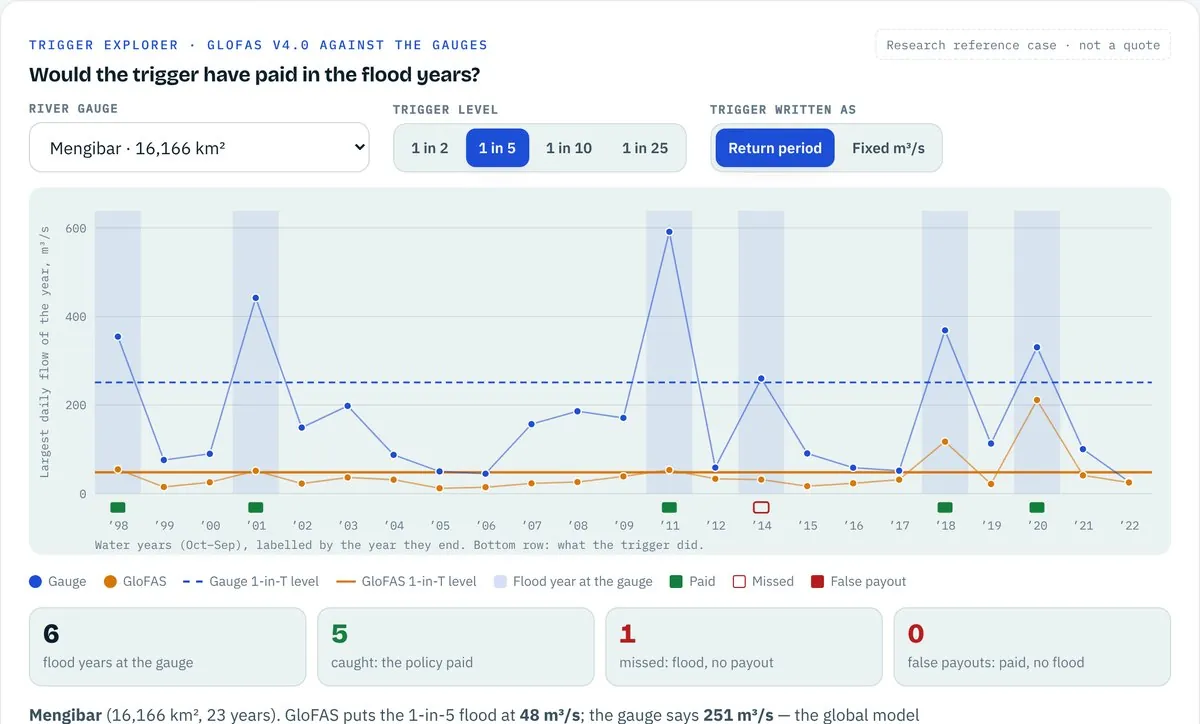
- Basis risk measured before the policy is sold
- Four trigger methods compared on the same years
- Uncertainty bands on every return level
- Design floods for engineers from the same study
How it works, step by step
Site
Your location, the asset and the cover you need.
Snap
Moved onto the river by catchment size; small streams flagged for a local study.
Fit
40+ years of GloFAS v5 annual floods, GEV and Log-Pearson III with bands.
Design
Four trigger methods, with attachment and exhaustion.
Back-test
Hits, misses and false payouts against gauges or records.
Deliver
A trigger sheet and a method note you can file.
What powers this solution
Interested in parametric flood triggers?
Contact our team today, or start in the KAI portal.
Guides on this topic
- How to design a parametric flood trigger, and how to measure its basis riskDesign a parametric flood trigger in five steps and measure basis risk: on GloFAS 5.0, a 1-in-5 trigger paid 33 of 60 flood years, with 34 false payouts.
- Can GloFAS set a flood trigger where there is no river gauge?On 14 Spanish gauges, a GloFAS 4.0 flood trigger in m³/s paid in 6 of 60 flood years; GloFAS 5.0 raised it to 26. What that means for ungauged rivers.